
Free sample questions
Five SQE1 questions, five subjects
Every question below is a single best answer scenario: one stem, five options, one correct answer, and a citation behind the explanation. Nothing is gated. Read them, try them, and judge the difficulty for yourself before you create an account anywhere.
What you see once you answer
Marking a question right or wrong is the easy part. The screen below is the app grading an answer in Trusts: the option that was chosen, the option that was correct, and then a line for every one of the five saying why it is right, why it is wrong, or why it is true but not the best answer.
The authority sits underneath, in this case Re Londonderry’s Settlement [1965] Ch 918. Every question in the bank is built the same way, so a wrong answer is worth as much as a right one.
The same question, answered
![A practice question in the LexVerity Academy app after answering. An Incorrect banner sits under the five options, with the chosen option D outlined in red and the correct option E in green, followed by a written explanation, a separate line for each of the five options saying why it is right or wrong, and the authority Re Londonderry's Settlement [1965] Ch 918.](/_astro/question-answered.D3lQVXqJ_ZqKgLV.webp)
Question 1 · Legal System of England and Wales
A County Court judge is deciding a claim on which a Court of Appeal decision is directly on point. The judge believes the reasoning is wrong, and notes that the decision conflicts with an earlier House of Lords authority the Court of Appeal did not consider. What should the judge do?
Question 2 · Constitutional and Administrative Law
A licensing authority refuses a taxi licence under a policy that automatically refuses any applicant with any past conviction, regardless of its nature or age, without considering the applicant’s individual circumstances. Which ground of judicial review does this raise?
Question 3 · Business Law and Practice
A director causes her company to enter into a supply contract with another business that she personally owns. She mentions the arrangement informally to the finance director over lunch, but the matter is never placed before the board, and the other directors do not turn their minds to it before the contract is signed. Which of the following best describes the position?
Question 4 · Property Practice
A buyer completes the purchase of registered freehold land with the help of a mortgage. Completion has taken place and the transfer has been signed, but before the buyer’s solicitor submits the application to register the transfer and the mortgage, a burglar unconnected with either party breaks into the property. Which of the following correctly describes the buyer’s position at the moment of the break-in?
Question 5 · Wills and Administration of Estates
A testator signs his will in his study without anyone else present. Later the same day, two neighbours come to the house together, and in their joint presence he acknowledges that the signature on the document is his own. Both neighbours then sign as witnesses, each in the presence of the other and of the testator. Is the will validly executed?
The material comes back on its own
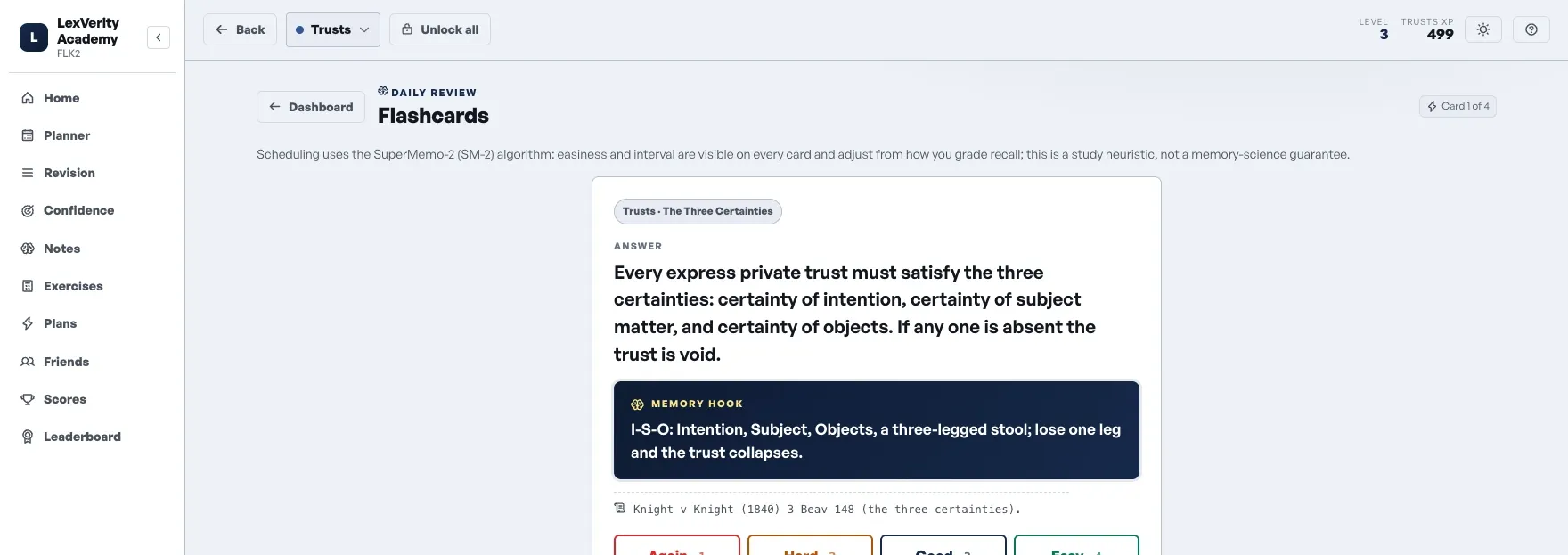
Cards are scheduled from the material you have already studied, so the app decides what you see today. There is no second deck to build and keep up to date.
Grade how well you recalled a card and it returns sooner or later than it otherwise would. Each card carries the same citation as the material it came from.
Daily review
Five questions is a taste, not a mock
A free account unlocks the first section of every one of the thirteen subjects, each with its own set of cited questions. Full mock assessments and the complete question bank sit on the paid tiers, and plans sets out exactly what each one adds.
If you want the wider picture first, see all thirteen modules, read how the course works, or compare the market on the SQE1 course comparison.
Questions about the free questions
- Where do these free questions come from?
- Each one is the sample question published on that subject’s own module page, in the same single best answer format used throughout the course: one stem, five options, one correct answer, an explanation and a citation.
- How do I get more than five questions?
- Create a free account. It unlocks the first section of every one of the thirteen subjects, each with its own full set of cited questions rather than five illustrative ones.
- Do the sample questions have citations?
- Yes. Each one includes a primary-source citation and a written explanation of why the right answer is right, in the same style as the full course.
- Is a card required to create a free account?
- No. A free account requires no card and is not time-limited.